The Loneliest Day of the Year

It’s Mother’s Day. The most depressing time of the year for me.

In the past, it never was that big of a deal. Oh, we’d celebrate the day. My brothers and sisters would all get together for lunch and shower mother with affection. We’d all give her cards, and sometimes flowers and gifts, but in many ways it was just another day for me. My Mother and I had a very special relationship. There wasn’t a day that went by that she didn’t know what she meant to me. My heart was always opened to her.

She died on Mother’s Day.

The date of this holiday changes every year, which seems to double the annual period of grief. Now there are two days when the pain of loss is amplified. The actual date of her death and the date nationally recognized as Mother’s Day.

I’m not a mother. I wanted to be. Desperately. But I lost my children: my hopes and dreams. My twins lost through a painful miscarriage. I feel that loss most on Mother’s Day when it seems everyone around me is celebrating. Restaurants and stores all herald Mother’s Day specials and promotions. Service employees try to recognize the mothers they serve and in doing manage to push that painful button for those who had sought that role but suffered infertility or loss. And distracting yourself in social media is not the answer on this day. Being “triggered” takes on a whole new meaning for people like me on Mother’s Day. It’s better to stay away from the crowds.

It’s raining today. Not a good day to hike or explore, which always help lift my spirits. The steady drops against my windows seem to mirror my mood. I hurt for the life I missed, for the relationship I would have had with my son and daughter. I miss my mother. Before I start another project to fill the hours, I’m taking a moment to feel the sadness, to remember and to grieve again. Maybe that’s not such a bad thing. Maybe that’s a kind of celebration of Mother’s Day.

Tears are often memorials to love, which is by far the greatest gift of life.

TIME AND TEARS: Thoughts on Friendship & Grieving

She cried in the morning.

I lay in the bed across the hall and wanted to go to her, to comfort her, to just hold her while she grieved. But it wasn’t my arms she wanted to feel around her, it wasn’t my words she needed to hear. In those early hours when the first rays of sun seep through the seams in the shutters, she needed the man who had brought her coffee and eased her into morning with gentle touches, whispered words and a sense of belonging that could only be found in the blanket of love. He was the only one with whom she’d feel safe enough to share her grief, but he was who she grieved.

When the tears would dry enough to allow breath, she would find her way through the fog. That’s when the mask would shift into place. She was suddenly calm and focused, organizing schedules and making plans, directing everyone around her with the strength that made others feel safe. She was always on the move and yet somehow possessed a stillness, an innate ability to listen and know how to provide the comfort she didn’t feel.

We are so much alike. She would only grieve alone or through the words on a screen, apart from the love she so desperately needed and the compassion that could deter her grief rather than become a conduit for it. I stayed at her side, sometimes talking, sometimes quiet, always feeling, but never crying.

She only cried in the morning. It was going to be a long journey.

That’s not what people want to hear. It’s not what society has taught us to expect. We’re taught about the stages of grief, as if it can be broken down into bullet points and action steps. We’re told it takes time, that the experience will be different for everyone, then we’re disparaged and pushed to move on when the mourning persists longer than what others think is reasonable. They don’t understand the sadness, the new responsibilities, the everyday losses that suddenly come to light after we lose a loved one. They don’t understand the hopelessness. When time passes without response, they stop checking in and stop giving invitations. Their lives go on while we struggle to keep our heads above water. And we watch it, sensing another wave of sadness on the horizon, but unable to do anything to stop it.

I think of that as I sit with another friend. She’s recovering from a brutal cancer treatment. Although physically she has bounced back, mentally and emotionally she is struggling every day. Anxiety and fears peck away at her confidence. People make her anxious; being alone sends her into panic. Day-to-day chores and activities have become a challenge; her focus is foggy at best. Worse, her inner voice tends to be more shaming than encouraging, telling her she should be stronger, she should be better. She resists those thoughts almost hourly, determined not to let them take root. She fights the demons of depression that seek to dig their talons into her, but she’s tired. So very tired.

She misses the woman she was, the strong, independent social butterfly. That woman could very well be a character in a book she read years ago, the details hazy and forgotten. She is separated from that reality. When was the last time she laughed? Felt joy? Was it all an illusion? It doesn’t feel like anyone understands how deeply she mourns for herself.

She only cries in private, where no one knows, where no one tries to explain or fix. Where no one expects the old her to show up.

When my partner lost his father, he was barely able to breathe. He was buried beneath the pain of loss, unable to deal with the knowledge that he would never see him again, never hear his voice, never feel the comfort of his love again. He closed himself off, unable to deal with any light or life that pierced the darkness in his soul. The comfort offered by friends and family felt like expectation. It left him frustrated and anxious. He wanted to be left alone., but that wasn’t what the people around him thought he needed. He became angry at their good intentions until they became bricks stacked one by one on the walls between them. It’s almost a fortress now, a sanctuary away from the emotional demands of friends and family.

He only cried in darkness. It helps him; it hurt the people who loved him.

When my mother passed, I went through the motions. I took time off to grieve, to travel, to learn to breathe again after being her caregiver for so long. I stepped back into a life I didn’t recognize or want, with emotional demands that were foreign to me, with fears, anxieties and a seething anger that threatened to erupt at any moment. My friends didn’t understand. Even if I’d been able to find the words, I didn’t have the strength to explain. I was being buried alive by the burning pain and the ash of grief.

My friends tried to pull me back into the circle. I remember the invitations, the phone calls, the impromptu visits asking me to talk, to explain why I couldn’t talk, begging me to say anything. I wanted to find comfort in their concern, but I didn’t. I felt the demands and disappointments, the needs I couldn’t meet. The waves of mourning were ripping through me, and they became the rocks I was tossed upon, tearing at my body and ripping at my heart. I just wanted to get away, to run away from everything that was once safe and familiar but had become a cross I couldn’t bear. So, I did.

I only cried alone.

I remember that time as I stand on the sidelines of grief. I’m in that position a lot lately. Too many friends are dealing with loss, struggling for air in this life they now face. I see the weariness behind the masks they wear and the weight of the walls they are silently building. I can almost hear their footsteps as they run away, seeking new people and places, anything but the painful familiar. I know they are looking for that place to freely grieve without the demands of who they were and what they’ve known pulling on them. But I want to be their safe place. I want to be their friend. It’s not easy.

There’s a delicate balance between support and expectation when dealing with someone in mourning. You want them to know you are there to share their grief, to hold their hand in the silence and embrace them through the darkness, but you don’t want the knowledge to become an expectation, the experience to become a burden. You want them to have the freedom to heal, but you need to be with them. You were with them on the mountain top and now you want to be with them in the valley, good times and bad, because that’s what love is, right? Or is it?

I’ve been reaching out. Consistently. I feel the rejection. Consistently. I try to focus on what they need, but it’s not easy to know. Everything has changed. I know that. They are mourning, adapting and morphing. They are becoming. Too often that happens in silence.

Relationships demand two-way communication. That’s never more apparent than when one side goes silent, or when they disappear.

It’s hard to reach out without response. To spend weeks and months sending notes, making calls, and just “showing up” to only get very brief responses, if any at all. I’ve tried to quietly walk with them on their journey. Words and actions become conscious decisions, deliberately thought out so they won’t feel any pressure. But I worry. What if they don’t feel my genuine love for them? What if my caution doesn’t show my care? What if I pour out my heart and allow myself to be “normal,” and it comes across as some kind of pressure for them to respond in like. It’s an emotional tightrope to walk, but it’s nothing compared to what they are going through. It feels selfish to make this about me.

I worry for answers. Am I expecting too much? Not enough? Am I being needy? What if they need to be needed? Am I being too deep? Too superficial? Too boring? Am I being too quiet? I drive myself crazy wondering how to be what they need. I pray for guidance. I pray for peace. I pray they will have all they need to recover.

Mostly I just miss my friends.

This must have been what my loved ones were feeling when I was withdrawing inside myself. They were afraid of losing me. Their fears became an albatross around my neck. In my grief, I didn’t realize they were grieving for me. Until it was too late and I vanished. Or maybe they left. It’s hard to say. When I resurfaced from the depths of despair and found my equilibrium in the new world I would live, they were gone. And I found myself grieving again.

I understand now. Grief is a tangled web with threads weaving into unforeseen areas and unimagined depths. There’s no definitive path or secret to survival. There are no real answers, except maybe one: love. When I think about what I needed, what my friends will need, it is all I know for certain. Love when they are mourning, love when you are hurting. Love when you’re close, when you’re distant, when they’ve gone and when they’ve returned. Love the person the person you are and the person they are becoming. Life will go on, and it may be different, but love never fails.

Until then, I will cry when I miss them.

Cassis

The steep walls of stone and green would be a fortress,
if not for the azure welcoming waters, and
the song in the breeze:
Calypso calling.
She is in the silence,
in the moss on stone.
Life pushing through
the cold, hard surface
towards the sun,
towards the water.
In crashing waves
that chisel and changes
a rocky landscape,
she thrives.
Unshaken.
Her song is the mist on my face
from the breeze off the water.
That’s what I tell myself;
the excuse I give.

Poulet Chasseur

I’m a Francophile. I admit it. I love all things French. Well, most all things. Enough to make a yearly (sometimes quarterly) trek to absorb the wonders of my heart home.

I have often tried to create the magic here in the states. It has proven impossible (Le sigh).

Except in the kitchen. La cuisine apporte de la magie.

One of the best gifts I received for Christmas this year was a French Cookbook. It includes a special story of a restaurant growing in the vineyards of a small country French village, along with their most loved recipes. I’ve decided to start the journey of trying all of them. An achievable goal for the new year, and one that brings my family and friends great satisfaction and happiness.

So, for tonight:

Poulet Chasseur

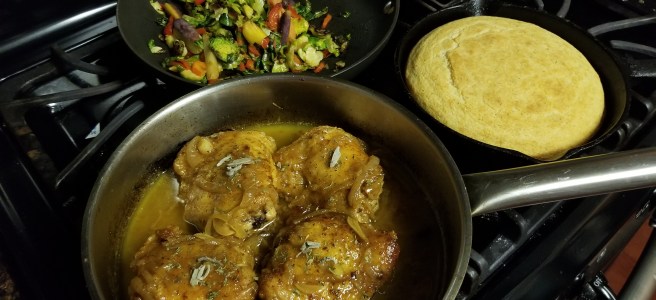
It’s a lovely chicken dish with a cognac butter sauce. To say it was delicious is a bit of an understatement. I especially loved how the garni added a fragrant and flavorful bouquet to the sauce, but an added plus: it left a lingering, mouthwatering smell in the house.

I served this dish with jasmine rice, a vegetable mix of brussel sprouts, red peppers and carrots, accompanied by a slice of herb infused cornbread.

In the end, my dinner was better than yours.

Bon Appetit!

KNIT A NEW LIFE

“Practice.” It was the last thing I wanted to hear. I wanted to be told the secret to success, the tricks learned from experience and the shortcuts that make it easier. I wanted to be told what to do. Instead, I was directed to YouTube teaching and problem-solving videos; sentenced to figuring it out on my own. Alone. As usual. I’m always alone. I really should choose hobbies that are more social.

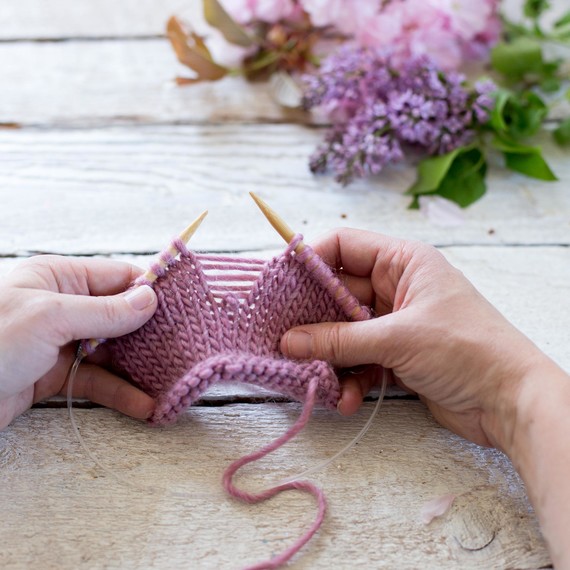
I looked down at the uneven stitches and twisted edges, the gaping holes in the pattern. I wasn’t completely certain some of the lines even held the correct stitch. My new stitches were disconnecting the previous, and each new row seemed to hopelessly alter the design. It was pathetic.

There had to be some way to make repairs, a way to stretch the yarn and pull it into place, a band that could frame the edge, an extra stitch that would fill the hole. But I didn’t know how to do any of that. I didn’t even know how I’d made the mistakes in the first place, much less how to correct them. I had to face a harsh reality. My limited knitting comprehension was holding me back, preventing me from consistently creating clean rows in even a basic pattern. How could I ever hope to repair the damage I had done? The problems I had created?

So, I unraveled what I had done.Image result for beginners knitting problems
If only it were as easy to clean-up all the messes in life. If only a simple pull on the threads of delusion and self-importance that bind past decisions to a hopeful future removed the knots of guilt and regret that alter the present course.  If only it were as simple as releasing the stitches of pain that have been weaved into joyful moments, irreparably altering beliefs and meaning.

There are countless books, movies and shows that explore this very idea: if you could go back in time, armed with the knowledge won from your mistakes, to create a new reality without experiencing those very mistakes, how would your life change? It never works out. Unraveling a flawed life is not so easy.

“Start again until you get it right.” My first real knitting advice.

I count the loops as I cast on with the same yarn and the same needle.

This is the time of year when our unrelenting desire to start anew is most evident. We spend weeks focusing on thankfulness and forgiveness, on love and kindness, on the importance of giving – not just gifts, but of ourselves – to family, friends and strangers alike. We unravel the bitterness and despair to begin counting our blessings. Then, we start the New Year with a resolve to be better. We make resolutions to have a better diet and exercise more. We determine not to be so quick to anger. We will volunteer more, save more, be more vigilant in taking steps toward our goals. We make resolutions that set ourselves up for failure. In a few days or weeks, we will sink back into the same eating habits, spend weekends binge-watching shows instead of exercising, hate our jobs, resent others and generally find reasons to build walls to keep others out.

Maybe peace is just a season.

The new stitches are a little more consistent, the edges are straight, but there’s another hole in my knit. I think I lost the pattern. Or maybe I held the yarn on the wrong side of the needle.

We are so ready to make a change, so anxious to make things right. If only we approach the problem from a different angle, if we make the opposite choice, everything will just fall into place. Or will it?

In fiction, when the hero goes back in time, the new path isn’t always a good one.  He saved his wife but dies in her arms. She dates other people, but still ends up pregnant and marrying the same man on the rebound. He has a family now, but is too broke to pay for his kid’s cancer treatment. She’s rich, but alone. What is lost is never what is gained. Even when it does end up with a happy ending, someone else pays the price. She gets the guy, but the sister grows old alone and barren. He gets the contract, but the other guy is homeless.

There’s a new hole in what I’m working on. It’s a different stitch, but the pattern is still flawed.

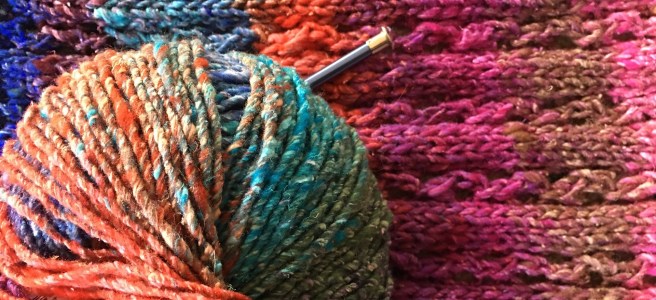
This time I’m using larger needles and a bulkier yarn. It’s more difficult to cast on and I find myself concentrating harder on each stitch. The needles feel awkward and the yarn heavy. The entire process feels different even though I’m working on the same pattern. I struggle to find a rhythm.

I remember when my mother died, I was desperate to create a new life. It was the perfect time. I had been out of work for over a year as I cared for her. I wasn’t in a relationship. My family was spread out over the states. The friends nearby had lost connection and the friends that stuck around were far away. I could truly start with a fresh slate. A new job, new place, new friends. I could develop new habits and new skills. I could create a new life.

I pulled out memories and emotions, I grieved over loss and I cried at the scars that marred by heart. My Mother was gone, and with her my friend, my support, and my identity as a caregiver. I didn’t want to go back to my career. I couldn’t go back to pursuing my dreams. Time had been against me. I would never have the family I longed for. I had to mourn the children I’d lost and the children I would never have. I had to come to terms with that empty place where a partner should be. I had to release a lifelong dream, forgive and forget.

Unraveling a life is frustrating and painful, but it mostly comes as a relief. I could travel, and so I did. I could paint and write, hike and swim; I could pursue any interest or hobby I desired. I didn’t need to be bound by a pernicious mortgage, or a house once prepared to receive a family, but now full of empty and aging. I was no longer weighed down with family expectations and responsibilities. Everything was new, except for me.

The stitches were too tight. The yarn covered an abundance of issues; you could hardly see the flaws. But this fabric wouldn’t breath. It was thick and heavy, and I hated it. It may have its uses, but it wouldn’t serve its design.

There’s a knitting shop not far from where I live. It sells yarn and knitting supplies, but also has a knitting community. When I visited, there were eight women and one man seated around a table, each knitting their own separate project while talking about their lives. They were obviously close; the camaraderie was evident. I knew instantly they weren’t just a group with a common hobby, they were a group of friends working through issues in both knitting and life.

The manager of the store was welcoming, and when I explained I was learning to knit, he was very open with suggestions and advice. There are a lot of tips to be found on the internet, but having someone who has been through it tell you their story and work with you makes it easier. Maybe it just eases the frustration. Or maybe it helps to not be alone on the journey.

I was raised in the Christian church, and fully embraced that through Jesus, God was restoring what was lost. “Old things are passed away and all things are become new.” It wasn’t that sin no longer existed, or that we were no longer flawed. Evil still would be present in the world; man would still cause damage and be damaged. There would be pain and suffering, sickness and disease. But the birth of Jesus, his death and resurrection, that was the new path. There would be no need for rituals and sacrifices – for wrath and destruction – to bridge that gap between man and God. Nothing would separate us from His love. The twists and knots, the flaws and holes, were all unraveled and in a relationship with him, we could start new and create something beautiful.

There are other religions that explore similar concepts, and even atheists tend to seek this kind of change through history and science. The need to have a fresh start, to find the path to a more enriching life seems to be part of our DNA. We may go about it from different angles, but at the root there is always that drive to unravel it all and start again.

“It’s hard to believe you’ve been knitting for such a short time.”

I was puzzled by the words. I looked down to see where the stitches were loose, and the yarn twisted. I saw the flaws; she saw the art. As I began to look at it through her eyes, I realized how far I had come. The edges were straight, I had properly transitioned between stitches, and there were no holes in the pattern.

Image result for knittingAs I was knitting, I was able to feel when the yarn didn’t slide across the needles correctly and immediately realize I had the thread on the wrong side of the needle. I could discern when the stitch was too tight or too loose then adjust accordingly. I could feel the stretch before it became a ladder. All the practice hadn’t made my knitting perfect, but it had allowed me to learn to course-correct before too much damage was done.

Maybe that’s the point of unraveling. Whether you come back with the same tools and pattern or start with everything new, the journey will always truly begin with you. We can’t undo the past. Forgiveness doesn’t remove scars, time doesn’t fill empty hearts and new circumstances won’t change who we are inside. Real change is rarely about time or tide. It’s in our ability to adapt and adjust, to edit and modify as we walk along the path. It’s in our ability to find peace in the necessity to start again until we get it right.

I found a hole in my pattern. It was a mistake I quickly learned to fix.

It was in the practice. After all, you need to have a history to know the kind of help required.

It was in the question. Sometimes it takes more than reaching out to an expert and hoping they will help; sometimes you need to ask the right questions.

It was in relationship. Sometimes you need to find the people in your life who want to walk the journey with you.

It was in the experience. You need to be open and willing to share those fears and flaws knowing that all you really need is weaved in that blanket of mistakes.


Depressed and Disappearing

The report of Robin Williams death from suicide rocked the world.

Depression sucks.

Too many people find it easy to pass judgment, making shameful accusation and calling the victims of depression “cowards” for taking the easy way out. Anyone who has walked the path of depression knows every step takes courage. You don’t wake up sad one day and say “I’m sad, I think I’ll commit suicide.” It’s a long journey of weight and pain and melancholy. It’s an hourly battle that never lets up; a fight with a dragon whose talons are so deeply imbedded in your skin every move creates a deeper cut.

Robin made people laugh. He was generous with his time and his heart and his gift. He chose to put others before himself most of the time. That’s not an uncommon approach. Helping others gets your mind off the pain for a few minutes at least. But in the darkness of night the demons are restless. In the quiet places, there’s a cacophony of hate and shame. In the mundane tasks of life, there is a rhythmic pounding of a pressure cooker in the soul. The silent places are torture chambers for the depressed.

I was never a depressed person. I had moments of sadness, sometimes even melancholy, but for the most part I had a faith that carried me into a space of peace. I had my faith, I believed in myself, I made people laugh: it helped me rise above circumstance.

But earlier this year I had thoughts of suicide.

A few days after my birthday, during a long drive home, I internally collapsed beneath the pressure. Too long carrying the burden, too long alone, too many life blows and relational disappointments, a failed support system: I was too weak to take another step.

Clinical depression and situational depression are two very different entities, but the emotional distress and the altered vision is often very similar. Both situational depression and clinical depression share a common bundle of symptoms: Feeling the blues, loss of appetite or increased appetite, change in sex drive, trouble sleeping, lack of energy, apathy, problems concentrating, feelings of guilt, physical pain, agitation, feelings of hopelessness. However, the length of time for situational depression symptoms usually coincide with the duration of the stressful event(s).

This is where it becomes difficult for the long-term unemployed.

You see, situational depression is quite normal for the unemployed, but it is important to note, the unemployment itself is often only one of MANY stressors causing depression. Life happens regardless of job status. There will still be problems with the children, there will still be deaths in the family, miscarriages, and accidents; natural disasters and the world economy will still create anxiety and fear. Ironically, some of the most common stressors that bring about situational depression often accompany long-term unemployment, such as relational strife, divorce, loss of income, failure of goals, loss of self-esteem and physical illness.

The normal response is to grieve over these situations, knowing the depression will typically remit once the stressors are no longer present, or it will decrease as one learns to cope with the disturbing situation. For the long-term unemployed, the stressor doesn’t go away, it remains a catalyst for more stress, for more symptoms and more situations. Normal coping mechanisms, such as exercise, good diet, taking a break from negative input, and changing your world view, simply do not work. Coping takes a backseat to survival.

The job hunter faces rejection every day, hopelessness every day, judgement and shaming every day. Lack of income results in limited food options, and the pervasive sadness makes exercise almost impossible. This kind of situational depression is very debilitating, and all too common for the long-term unemployed.

So on that long drive home, I thought about accidental death, which would be easier for my family to mourn, would relieve their burden and certainly end my pain.

I found myself dictating a letter to my family and friends. I was angry at myself for planning it, ashamed I’d sunk so low. Those emotions only fueled the defeat. I just wasn’t strong enough to go on. I was tired, exhausted, bone weary from a journey that had me traveling the river Styxx, battling giants and demons and Satan himself. It hadn’t been a brief detour. It hadn’t been a small mishap down the mountain, or a pothole in the road. It had been years of one blow after another without any time to heal or recover. I had been bleeding out, hemorrhaging internally, and now I had gone into shock. My systems were no longer working properly, and I was alone.

When I had felt the weakness overtaking me, I had reached out for help. It wasn’t easy. It’s never easy to be so humbled; it’s never easy to admit you’re broken. I wasn’t asking for monetary assistance. I have never asked for that. I know that without a job, without an ongoing plan of action, any financial assistance is just using a teaspoon to ladle the water from a sinking ship. So, when I reached out, I was asking for an ear, a shoulder, perhaps even a creative brainstorming session. Mostly, I just needed hope.

I wanted to make certain I was concise with my words; my humor has a tendency to hide or override the severity of what I am feeling. I told my small group of friends: “I’m not doing well; I can’t take any more; I’m breaking.” I tried to be clear it wasn’t just the job loss, or my mother’s illness and death, or the miscarriage, or even the loss of friends. It was the systematic breaking down of hope and faith and self-worth. Five years of life-altering events. One was enough to justify grief and depression. The compounding events were crushing.

Comfort didn’t come as expected. Life has a way of bringing biting flies, stinging scorpions, and vicious scavengers before a good Samaritan can arrive.

I remember the Saturday I received a call that proved to be that start of a new blow. I was placed in an impossible situation. In the end I had to remove all emotion and view the situation from a lens of honesty and integrity, in truth and obligation.

When I hung up the phone, feeling trapped and defeated, I knew I’d done the only thing I could do. The wheels were already in motion: evidence had been viewed, and action was already being taken. Denying, hiding and protecting would only ensure I would be sucked into the storm as well. It would devastate me.

As it turned out, the chain of events that followed almost did. You see, the day-to-day dramas and annoyances feel insurmountable when you carry the lead skin of depression. Personal attacks, faulty assumptions, accusations, gossip, social freeze-outs: these are intermittent storms of destruction to an already beat and battered emotional landscape. People rarely understand this aspect of the long-term unemployed experience. The things considered trivial, small pebbles thrown at the “average” person, are crushing boulders to the long-term unemployed.

I felt like Wiley Coyote, crushed beneath the Acme weight and a mountain of rubble and debris. The world moved on: Beep! Beep! It would continue to move on.

After the long drive, I walked in the house and looked through the mail, numb but resolved.

The box I opened that day would change everything.

To Be continued

How It Happens: The Downward Spiral Part 2

Your realtor tells you to talk to a lawyer who specializes in foreclosures, who can advise you properly. She has the name of someone who’s helped quite a few of her clients.

How will you ever pay for a lawyer?

You call and leave a message, then wait the nail-biting two days for a response.

The mortgage company is still jerking you around about the loan modification papers, asking for clarifications, letters and signatures to back the information that has already been certified.

And they continue to return your payments.

You talk to your roommate, guilty and sad that it is going to affect him, too. It doesn’t matter that he knew the situation going in, that you kept him abreast of the job search and the uncertainties you were facing. You still feel like you’re letting him down.

You start cleaning house. There are things you don’t want to risk losing. Mostly your mother’s things. You stopped being sentimental about your own things when you were forced to start selling them to make ends meet.

But her life mattered. Her memory matters.

Remembering how she loved you, believed in you brings more shame.

What a disappointment you are.

And yet even now you hear her voice. She would never be ashamed of you. Not even now. You know beyond any doubt, her love for you never wavered. She would cherish each shattered piece of you. It somehow brings comfort.

People tell you to be strong, go to church, stand on the Word. Some pray, some cross their fingers, some send good wishes. Mostly people feel afraid because they don’t know what to say, so they disappear. You’ve been there before; it’s not an unusual response. The friends who say “I don’t know what to say” then talk you to distraction are a relief. For a few moments, you can feel normal. For a few minutes you have a place.

The lawyer says to take a deep breath, it’s going to get worse before she can step in and hopefully make it better. There are no guarantees.

You’re barely treading water. That means you’re going under. The “deep breath” is good advice.

She has a plan, though. You have no choice but to trust her.

Trust is hard. Faith is harder. You remember when they use to be so much a part of your being it felt like they were part of your name. That was years ago. Before the disappointments. The miscarriage. The loss. That was before death had taken its toll and life had pummeled.

“If you need to talk…”

You don’t want to talk about it. You don’t want to think about it anymore. But it’s taken over your mind.

The light is getting dimmer every day. You’re not sleeping well and it’s hard to get out of bed. But you force yourself. You have to move. You have to keep trying, keep pushing. That’s what’s expected; that’s what you do. You may fail at life, but it won’t be because you slept through it.

More phone calls. More applications. More resumes. The only thing darker than the black hole of the job search is the black hell inside. That’s where demons reside. They have talons of humiliation and fangs of shame. They peck and bite and sneer. They mock you for believing you have something to offer, for thinking you still have value.

“Being hopeless won’t get you a job.”

“You need to think positive.”

“Every day is a new opportunity and you’ve got be be excited to embrace it.”

You feel the bitter shroud closing over you. The cliches are slaps when you need a soothing touch.

A friend from France calls. She sounds happy just to talk to you. You cling to the knowledge that it’s real. She’s too blunt to patronize. Besides, she happily gives you hours of her time. She doesn’t have to.

Another makes contact to tell you people only speak the best of you. She insists you are more than the circumstance.

You wish the voices across the ocean could mute the voices in your head. The ones that say “People are talking about you.” You can sense it, feel it in every interaction, see it in their pity-filled eyes, hear it in the judgmental counsel.

You find yourself raging on the inside, desperate to be free, to have the chains of bondage broken.

You think about the homeless you’ve seen under the bridges and along the sidewalks; their animated talks make sense now. A frightened soul can’t stay silent; a broken heart needs a voice to survive.

Your voice carries a pen. So you write.

This is how it happens.

Quickly, but in slow motion. Each step to the gallows accompanied by whispers.

I understand.

Today I gave John my granola bar. He’s a veteran, and homeless. For a little while, the voice he heard was mine. I hope he heard: “You matter.”

Click here for Part One: http://wp.me/p3HHLR-9g

Character

image

Character is doing the right thing when everyone else is willing to do the wrong, to tell the truth when others are willing to lie, to be transparent when others would hide a wrong-doing simply because it’s possible to get away with it.  Character isn’t always popular; it’s rarely easy and almost never recognized at the time, but in the end and it matters.  It endures the tides…